My work and Needs you
My work is where your day starts: what your team is doing, the next step in each area of the business, and one queue with every decision waiting on you. Sensitive actions wait for a person.
My work, from top to bottom
My work reads from top to bottom:
- Today across your areas — the next step in each part of the business.
- Needs you — every decision waiting on you, in one queue.
- In progress — what Enti and your employees are working on, with Open task board for the full board.
- To-do list — shared tasks for the people in your company. Adding a to-do does not hand work to Enti; Let an employee do it does (a paid run).
- Proposals — next steps your team suggests: Approve & run lets the proposing employee start, I'll do it moves it to your to-do list, Dismiss drops it.
- Recently finished, with History for everything older.
Give Enti a task at the top hands over new work, and the links under the title jump to each section with its count. Owners also find Today and this week folded at the bottom: what was delivered and what failed today, and today's spend in CHF. The sidebar badge counts the decisions you owe.
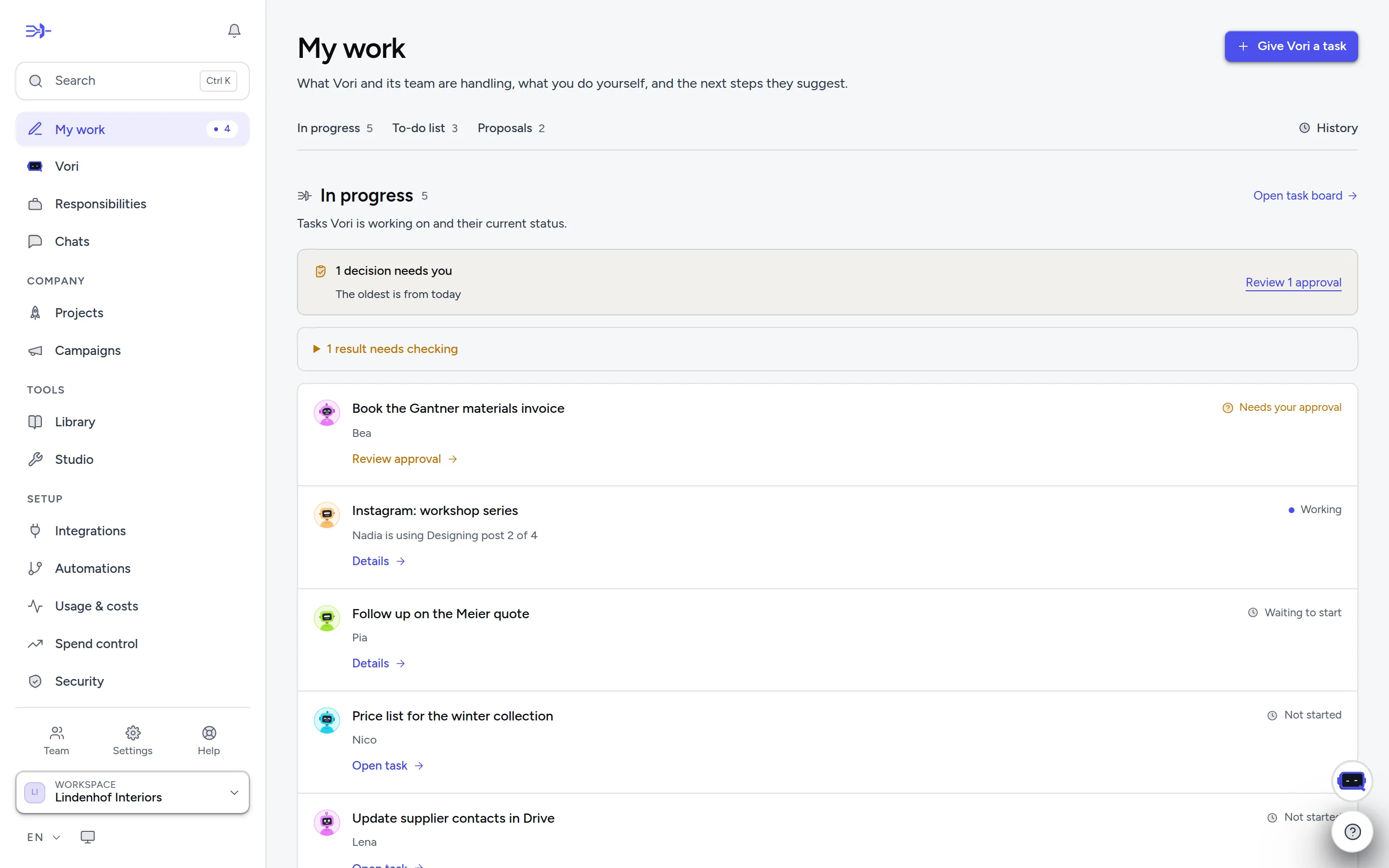
- 1“Give Enti a task” hands over new work.
- 2Jump to In progress, the to-do list, proposals or History — each with its count.
- 3Decisions waiting on you, with a link straight to the exact one.
Today across your areas
Today across your areas shows one line per area with its next step. Open a line to take that step where it belongs:
- Customers — replies waiting for your OK; marked late after two days.
- Finance — the next step on money customers owe you: a decision, a reminder, an offer with no answer.
- Post — letters waiting, only the ones you may see.
- Month-end close — where this month's close stands.
- Year-end — the year-end folder.
- Marketing — posts in the content calendar waiting on you.
- Deadlines — statutory dates in the next 30 days, and contract notice dates.
Areas with nothing waiting fold into one line. You only see areas you may open: Finance, Year-end and Deadlines need finance access; Month-end close shows to the owner, booking approvers and the named Treuhand reviewer. The strip updates when you open My work or come back to it; Refresh asks again.
Needs you: every decision in one queue
Needs you collects what waits on you from every area: approvals, your employees' questions, proposals, your to-dos, receipts, job reports, holiday requests and results that could not be confirmed. It groups them by what happens when you say yes:
- Work is stopped — an employee waits on your answer.
- Money and signatures — only an owner decides.
- Ready to go out — messages and posts.
- Other decisions, Ideas from your team and Your own to-dos.
- Could not confirm — results to check.
Pick an item on the list and decide it beside it, in place: the reasons, a preview and the item's own buttons. Next item and Previous item step through the queue, Show first priority jumps to the most urgent one, and Open on its own page shows it full size. Other areas link straight to their item here. To filter approvals by employee or kind, use Approvals & questions.
How an approval works
When an employee reaches a sensitive or irreversible action — per your policy — it asks. The run waits for a few minutes (the approval wait, set on the Security page); after that it carries on with the rest of the work and the request stays open — a late approval is still carried out.
Decide wherever you meet it: on Approvals & questions, in the yellow band of a live run, in a 1:1 or team chat, in the follow-up chat, on the Security page, or by asking Enti. Each card offers Approve, Reject (with a reason), Request changes and, for drafted messages, Edit text. A 10-second Undo follows sends, payments, signatures and deletes.
Every approval card reminds you the action was AI-prepared: check content, amounts and recipients before approving. Approving authorises the action — responsibility stays with the approver.
Fewer, faster decisions
- Approve all similar covers this task's look-alikes in one decision (every booking step counts as similar, at any amount).
- Stop asking turns a decision into a standing rule — listed under Standing rules on the Security page and re-confirmed every 90 days.
- On the Approvals page, Approve all shown decides a filtered list, and identical questions from several employees are grouped — Send to all answers them at once.
- In the card deck, swipe right to approve, or left to give a reason and reject; Remind me puts a decision on your to-do list.
- Decision history lists past decisions and exports the audit trail as CSV.
Who may approve what
Any member can approve everyday outbound work — an email, a customer reply, a marketing post, a CRM write. The actions that move money or can't be undone are owner-only: paying or moving money, writing an accounting record, requesting a legally-binding signature, deleting data, granting permissions, and turning a decision into a standing rule.
One exception: a member the owner marked May approve bookings (in Settings → Company & team → Members) may approve the booking steps employees prepare — never payments, anything sent to customers, deletes or signatures. See Who sees what.
Rejecting is never restricted — any member can stop any action, so nothing dangerous waits on one person.
Tune the rules
The approval policy is per workspace, on the Security page: which kinds of action need your approval, the single-payment cap, a recipient allow- and denylist, and the monthly run and spend caps. Per connected tool you set reading and writing separately to Default, Allow, Ask first or Block.
The approval pause is the default, and an owner can relax it — auto-approve records below an amount, monitor mode, standing rules, an employee's earned trust (Allow without asking on its scorecard), per-tool Allow. A per-tool setting never waives the safety guards (secret and personal-data leaks, deletes, untrusted web content), and in every mode, monitor included, leak blocks, the single-payment cap and a human look at irreversible deletes still hold.
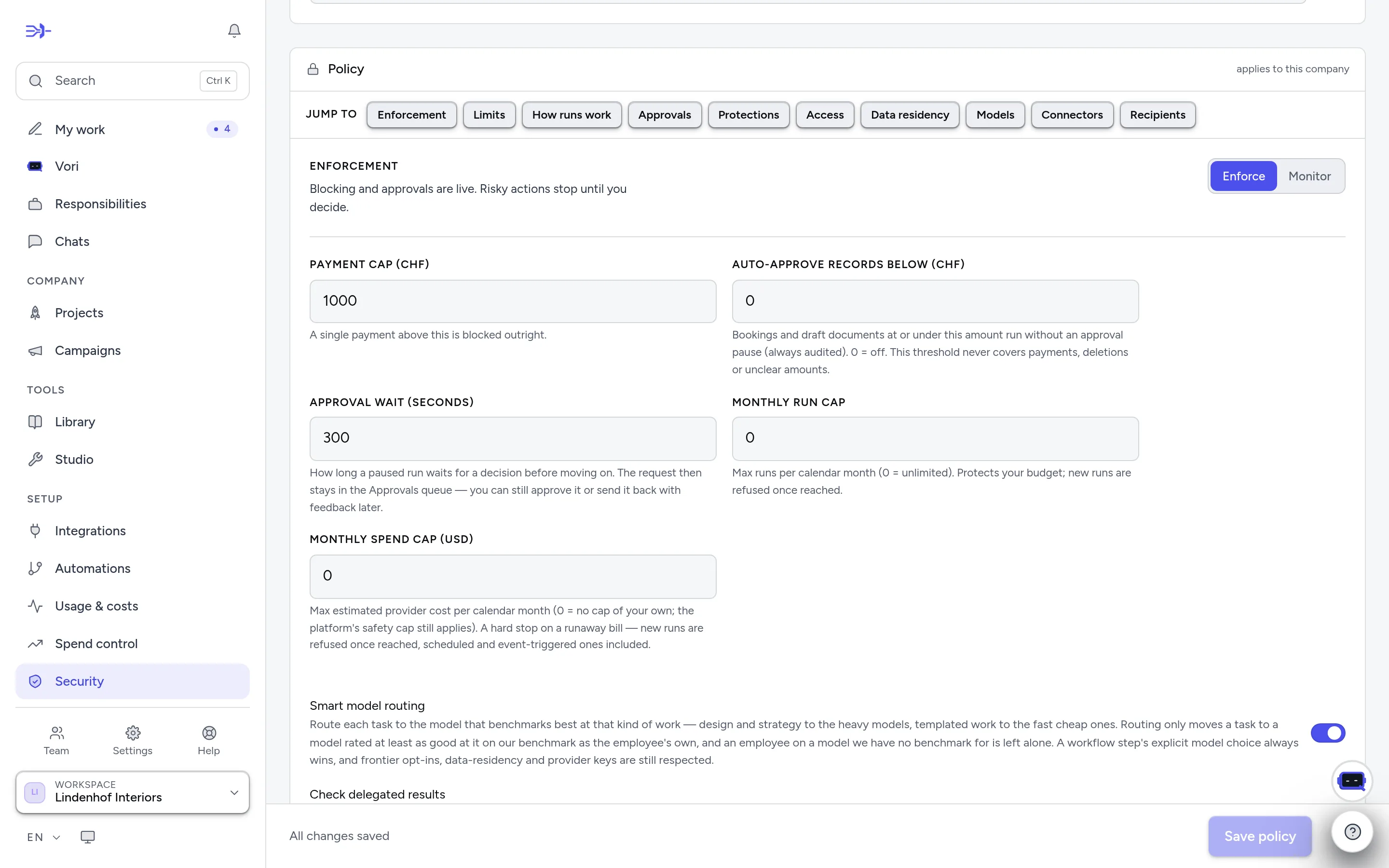
- 1“Jump to” any part of the policy — enforcement, limits, approvals, connectors, recipients…
- 2“Enforce” blocks until you decide; “Monitor” only logs what would have been asked.
- 3The limits: the single-payment cap, auto-approve below an amount, the approval wait, and the monthly run and spend caps.
The Monday brief
Every Monday morning Entumo puts together the Monday brief: what needs you this week, your cash, and last week's AI work. It lists overdue invoices, supplier bills due within 7 days, statutory deadlines in the next 14 days, letters with a deadline in the next 14 days, customer replies waiting for your OK, your cash today and what is expected over the next 30 days. It only reads — it decides nothing and costs nothing.
Everyone in the workspace gets a notification that opens it, and each person sees only the lines they may see: the money lines need finance access. It also goes to the workspace's notification channel set in Settings: the whole brief by email, or a link on Slack, Teams, WhatsApp, Threema or a webhook. Monday brief on My work opens the brief any day with today's figures. A quiet week sends nothing.